A live website is never really finished. Technical components evolve, security flaws are discovered, opening hours change, a photo needs replacing.
A maintenance contract is there to organise all of this. But two contracts at the same monthly price can cover very different things. A vague contract opens the door to unpleasant surprises: a request you thought was included and gets invoiced, or an incident nobody takes on.
Here is what a maintenance contract should spell out, point by point. We use our own contract as an example, with its real figures.
1. The foundation: what maintenance should cover
Whatever the price, a maintenance contract should at least specify:
- Technical updates: which ones, and how often
- Backups: how often, and how a restore works
- Monitoring: who gets alerted when the site stops responding
- Fixing malfunctions
- The volume of changes included each month
- Reporting: how you know what was done
At Kayo, maintenance only covers the operations and frequencies defined in the quote and its “Scope” appendix: updates, backups, monitoring, fixes, a monthly volume of small changes, and a monthly report of the actions carried out.
2. What should be clearly excluded
A good contract also says what it doesn’t cover. It’s less pleasant to read, but it’s what prevents misunderstandings. At Kayo, maintenance does not include:
- New features: booking, payment, members’ area, multiple languages, search
- A new design, a redesign or a new type of block
- Copywriting, translation, photos and videos
- SEO and advertising campaigns
- Integrations and automations between tools
- Bulk additions, beyond 10 items at once
- Problems caused by the client’s or a third party’s intervention
These requests aren’t refused: they are defined and priced separately, before being carried out.
3. How changes are counted
“Unlimited changes”, “small edits included”: without a unit of measure, these phrases say nothing. Ask how a request is counted, and who announces the count.
At Kayo, the unit is the small change, of about 30 minutes:
- A small change counts as 1: a text, a price, opening hours, up to 3 photos supplied, an item added to or removed from an existing list, a link or a button
- A medium change counts as 3: a new section with existing blocks, a simple page on an existing template, a simple form, reorganising the menu
- Beyond that, the request gets a quote
One request equals one topic, and the count is announced before any work: you accept, postpone or ask for a quote. Our packs include 2, 6 or 12 small changes a month: Essentiel at €99, Confort at €199 and Croissance at €379 a month. Unused volume carries over to the next month only, up to 25% of the monthly volume (rounded up). Pack used up: €37.50 per extra small change, always announced beforehand, or carried over to the next month.
4. What should never be counted
This is the most important point, and often the least clear. If every bug fix is deducted from your volume of changes, you pay to repair what should have worked, and nothing is left to improve the site.
At Kayo, these are never counted:
- Bugs and incidents
- Security
- Technical updates
- Backups
- Monitoring
5. Written response times
“We respond quickly” is not a commitment. A serious contract sets response times by severity level, and defines each level.
At Kayo, these times are written into our terms of sale (article 27) and are the same in all three packs:
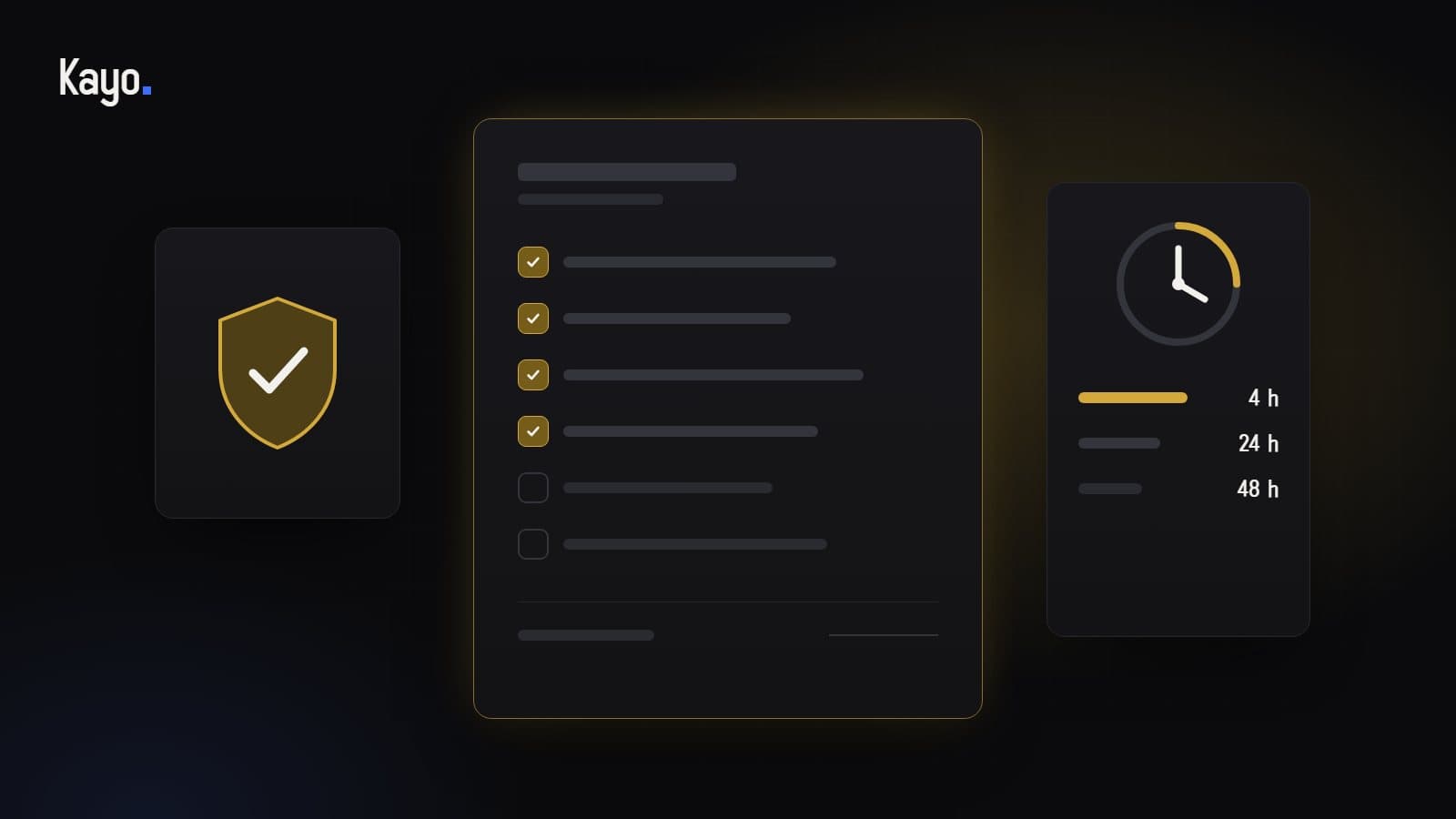
- Critical, handled within 4 working hours: the site is unavailable to everyone, a security breach is confirmed, data is being lost, or online payment is completely down
- Important, within 24 working hours: the site is still available, but an essential function no longer works (contact form, booking, automatic emails, main page unusable on mobile…)
- Normal, within 48 working hours: any other incident or covered request, such as a broken link, a display issue or a text error
Two details to check in any contract. First, are these response times or resolution times? With us, they are response times: resolution may depend on third-party services. Second, what do “working hours” mean? With us: Monday to Friday, 9 am to 6 pm, Brussels time, excluding Belgian public holidays, from your written report.
6. Taking over an existing site: the entry audit
Handing a provider a site they didn’t build means asking them to take responsibility for code they don’t know. An honest contract therefore includes an assessment before any commitment.
At Kayo, this entry audit reviews hosting, code, dependencies, security, backups and existing bugs. It results in a documented initial state. If fixes are needed to make the site maintainable, they are covered by a separate quote.
- Site not built by Kayo: entry audit of €125
- Site built by Kayo, then modified by you or a third party since delivery: entry audit of €125
- Site built by Kayo and not modified: no takeover fee
This entry audit is separate from the pre-audit, which is free and helps you choose a direction, not take over a site for maintenance. Problems that already exist at takeover aren’t covered by maintenance: the audit identifies them, and fixing them is priced separately.
7. Duration, notice and end of contract
Finally, check how you leave the contract. At Kayo:
- The Flex plan has no minimum term, with one month’s notice
- 6- or 12-month commitment plans come with a discount, shown in the quote
- Maintenance is invoiced at the start of each month
- At the end of the contract, on written request, we return within 30 days the access, files and data we hold, then remove our own access
Your accounts (domain, hosting, tools) stay in your name: we work with delegated access. Hosting, third-party services and licences remain your responsibility, unless the quote says otherwise.
The checklist before you sign
- Does the contract list the operations included and how often?
- Does it also list what’s excluded?
- How is a change counted, and is the count announced beforehand?
- Are bugs, security and updates deducted from your volume?
- Are response times written down, by level, with a definition of each level?
- Is an audit planned for taking over an existing site?
- What is the notice period, and what do you get back at the end?
- Are third-party costs (hosting, licences) listed separately?
Key takeaways
- A maintenance contract should state what’s included, what’s excluded and how requests are counted
- Bugs, security, updates, backups and monitoring should never be counted
- Ask for written response times, by severity level
- For an existing site, an entry audit avoids discovering problems after signing
All the details of our three packs are on our website maintenance page. Have a site you’d like us to take over? Let’s talk during a 20-minute call.